
What Is Performance Marketing and How Does It Work in 2026
Those days of “throwing spaghetti at the wall” just to see what sticks in your advertising are over. In the modern world that is dominated by AI, marketing has moved from guessing games into precise science. We’ve moved past the years when brands were happy being just another “vague awareness” and entered a period where every little rupee or dollar spent on marketing accounted for a tangible result. Performance marketing is exactly what it sounds like: a complete strategy which is driven by results. Unlike traditional advertising, where you pay upfront for a billboard or a TV slot just in the hope that someone sees it, performance marketing ensures that you pay only when a specific action, whether it’s a click, a lead, or a sale happens. What is Performance Marketing? At its core, performance marketing turns the traditional advertising model on its head. It is built on the foundation of real-time data and transparency. Brands no longer need to wonder which half of their advertising budget is being wasted; they can see which creative, which platform, and which audience is driving the most value. This shift is backed by significant numbers. A recent industry data showed that performance-based advertising now accounts for 60% of total digital ad spend on a global level. Today, businesses are moving away from “vanity metrics” like likes or impressions and are focusing on Return on Ad Spend. In fact, companies that use AI-driven performance strategies saw an average increase of 15% to 20% in their marketing efficiency as to those that use traditional manual bidding. How the Rise of AEO & GEO Have Changed Performance Marketing The current environment has introduced a new layer to performance: Answer Engine Optimization and Generative Engine Optimization. We are no longer optimizing for blue links anymore; we are optimizing for the answers provided by AI. In this model, “performance” isn’t just about a direct click from a search engine, but it is more about ensuring that your brand is the primary source that was cited when a user asks a question to an LLM. This is the new frontier of Brand Authority. Performance marketers are now measuring “Citation Share”, the frequency with which their brand is mentioned as a trusted solution by an AI engine, as a leading indicator of future sales. Performance vs Brand Marketing: The Strategic Split Feature Brand Marketing Performance Marketing Primary Goal Awareness and Sentiment Conversion and ROI Payment Model Upfront Per Action Success KPI Brand Recall / Reach Sales / Leads / App Installs Time Horizon Long term (Years) Short term to mid term (Days/Weeks) Core Value Trust and Identity Efficiency and Scalability How Performance Marketing Industry Works Today Today, performance marketing works through a sophisticated ecosystem of “Bidding” and “Attribution”. It is a fast-paced auction where machines are making decisions in milliseconds. How “Creative” Variable Wins the Performance Marketing Game Despite all the automation and the math, the most important variable in performance marketing is still the “Creative”. You can have the most optimized bidding strategy in the world, but if your ad lacks resonance with human emotions, it is going to fail. The data supports this: creative elements are responsible for nearly 85% of a campaign’s performance success, which has led to the birth of “Performance Creative” ads that are designed specifically to stop the scroll and drive an action, instead of just looking “pretty.” It is a blend of data-driven insights with human psychology. The Ultimate Scalability Tool Performance marketing is a great equalizer. It can help startups compete with a global business by spending their budget more efficiently. It is not about who has the biggest chest of gold, it is more about who can use their data to find and reach the right audience at the right time. If you are successful in proving that every $1 spent helps you generate $3 in revenue, your growth will become a matter of mathematics and not just luck. In this result-obsessed world, performance marketing is not just another Digital Marketing strategy, it is the heartbeat of a modern, successful business. Frequently Asked Questions Is performance marketing better than brand marketing? Neither of them is “better’”, as both work best together. Brand marketing builds the trust which makes your performance marketing ads effective. What is a good ROAS (Return on Ad Spend)? It is completely dependent on your industry and margins, but a common benchmark is 4:1 ratio (i.e $4 in revenue for each $1 spent). Can performance marketing for B2B companies? Yes, when talking about Performance marketing in B2B, the shift moves from immediate sales to lead generation and nurturing your leads through longer sales cycles. How has privacy regulation impacted performance marketing? It has made it harder to track users across the web, thus forcing marketers to depend on their own first-party data and AI-based modeling to predict results.
What Is High-Intent Traffic and Why It Matters for Conversions
Consider yourself as an owner of a high-end sneaker store, where you have two people walking into your store. The first person passes their time, waiting for their friend, and randomly looking at the display and commenting about the colors. Whereas, the second person walks directly towards the counter holding their phone with a picture of a specific limited edition model, just to ask, “Do you have this shoe in a size 10?” This first person is known as low-intent traffic. Whereas the second person is known as high-intent traffic. In digital marketing, the difference between these two visitors is the difference between a vanity metric and a growing business. If you need to scale your conversions without doubling your budget, you have to stop chasing “eyeballs” and start chasing “intent.” What is High-Intent Traffic? High-intent traffic is when a user searches for a specific problem or need to complete an action right now. These are not people who are browsing for an inspiration, but they are people who are at the bottom of the funnel, looking to make a purchase. Intent is signaled through Search Queries or Behavioral Data. Why Intent is the Conversion Multiplier You can have the most beautiful landing page and the most persuasive copy in the world, but if you are showing it to someone who is not ready to buy, your conversion rate will stay in the basement. Below are some reasons that state why high-intent traffic is the “holy grail” of marketing. Lower Customer Acquisition Cost High-intent users need less “convincing.” They’ve already done the research; they understand they have a problem, and they know what the solution feels like. Because high-intent traffic converts faster, you spend less on retargeting ads and a long list of email prospects. You’re effectively taking a shortcut to the sale. Higher Return on Ad Spend When you bid on high-intent in paid search, you might pay a higher price-per-click, but because the conversion rate is higher, the overall cost per acquisition is lower. It is better to pay $5 for a click that has a 10% chance of converting than $0.50 for a click that has as little as 0.01% chance of converting. Better Predictability Buyers with High-intent traffic will help you treat marketing like a machine and not another gambling game. Once you know what a specific signal leads to, a sale or just a search, you can scale your budget with confidence, knowing how much revenue you will generate. The Difference That Looks Like Window Shoppers vs Buyers Feature Low-intent traffic High-intent traffic Mindset Exploring Buying Search terms “What is…”, “Tips for…” “Best…”, “Review…”, “Buy…” Bounce Rate Usually, higher Lower Path to Sale Long and unpredictable Short and direct Action Taken Reading a blog and scrolling feed Adding to cart and filling out a lead form Why Precision Beats Volume On an average high-intent keywords have a conversion rate of 3x to 5x higher than general informational keywords. Companies that prioritize intent-based targeting report a 45% increase in marketing efficiency because they aren’t wasting impressions on users who aren’t in the “buyer window.” Search engines remain the primary source of high traffic. Research shows that over 70% of high-value B2B transactions begin with a specific, high-intent search query. How to Capture High-Intent Traffic You don’t stumble upon high-intent traffic; you build it. Instead of targeting “shoes,” target “waterproof trail running shoes for wide feet.” The more specific your query is, the higher the intent it carries. Identifying “high-intent” behaviors, like visiting the pricing pages three times or spending five minutes on a detailed product comparison guide. Use ads to stay in front of people who have already shown intent but haven’t pulled the trigger yet. You’re just giving them the final nudge. Stop Counting, Start Converting In the current digital economy, volume is a distraction. You don’t need a million visitors; you need the right thousand. By shifting your focus from “how much traffic can I get” to “how much intent can I capture,” you turn your website from a digital brochure into a high-performance sales engine. At the end of the day, a single visitor with a credit card in their hand is worth more than a thousand visitors with their hands in their pockets. Frequently Asked Questions Can social media drive high-intent traffic? Yes, but it is harder. Social media is a “passive” channel. To find intent there, you need to look at specific behaviors, like people clicking on “Shop Now” ads or engaging with product-specific webinars. Is high-intent traffic more expensive? Usually, yes, in terms of Cost-Per-Click. Because everyone knows these users are ready to buy, the competition is higher. However, the CPA is often lower because they convert so much better. Should I ignore low-intent traffic? No, Low-intent traffic is how you build Awareness. You need to educate people at the top of the funnel so that when they do develop high intent, they already trust your brand. How do I know if my traffic is high-quality? Look at your conversion rate and the time on the page. If people are staying long enough to read your product details and are actually clicking your CTA button, then you’ve found high-intent traffic.
The Future of Digital Marketing in the AI Era
You would have probably noticed that the internet is getting smarter lately. It feels like your favorite app can now read your mind. This is not about luck; it is because we have entered a brand-new era where AI is the main engine behind everything you see online. In the past, marketers had to gues what you liked. Today, they have AI that can look at millions of pieces of information in a second. This change is huge, in fact 94% of marketers are using AI tools to make their work fast and better. Below is a look at where the digital world is going and how it is changing the way you hang out online. AI – The Marketing Assistant You Need! Think of AI as an intern that never sleeps but learns faster. It can help you write 10 captions for a phone, edit a video, or design a logo all within few seconds. Because of this ability, experts believe that 75% of creative tasks will be done with the help of AI very soon, but this doesn’t mean humans are going away. It simply means that marketers can spend less time on the boring stuffs, like checking for typo errors, or more time coming up with big, fun ideas. AI handles the “science,” whereas humans handle the “story.” The Efforts For Scrolling Ends Now! For a long time, if you wanted to know the “best ways to clean white sneakers” you’d type it into Google and click on three different websites to search for teh answer. But this strategy is changing faster now. We are moving in the world of AEO. Instead of giving you a list of links, AI will just give you the answer, because 7 out of 10 users now prefer to get a quick summary from an I instead of making an effort to click 10 different pages, brands are racing to be the “source” that AI can trust. If an AI mentions your brand in its answer, your brand wins. Content That Knows You Better Than Your Friends Did you ever wondered about how an app is showing you exactly what you needed? This is called “Hyper-personalization”. AI can look at what you’ve liked in the past and then predict what you’ll want next. This is not just about ads for shoes. But it is more about making sure the videos, emails and the websites you visit change their “look” just for you. Right now, companies that use this kind of smart targeting have seend a 20% jump in sales because they aren’t just wasting your time with the stuff that you don’t care about. The Battle Against “AI Slop” Since AI can make your content fast, the internet is getting crowded. There are lot of “AI Slop” out there, posts and videos that feel robotic, boring and fake. This is indeed a huge opportunity for real people because there is lot of fake stuff present, which makes room for human-made content to become valuable. People are craving authenticity. In a world full of bots, being a real person with a real voice is a “superpower.” Brands that show the real people hiding behind the scenes are the ones that stand out. Video Remains the King Even with all the AI changes, video is here to stay. In reality, video marketing now accounts for 82% of all internet traffic. The future is about “short-form” video that sounds cool with AI effects. AI can also help a creator translate their video into 50 different languages in just few seconds, meaning a kid living in India can watch a video from a creator in brazil and understand every word. Where Does the Magic Happen? Marketing is moving off the phone screen and leaping towards real world with the help of things like: Welcome to the Human AI World We aren’t just moving towards a world run by robots, but we’re moving towards world where humans are using AI to become creative. The tools are getting fancy, but the goal still remains the same: helping people find what they need. The future of marketing it no more about being loud, but it is about being a smarter friend, a customer feels happy to find online. Frequently Asked Questions Will AI take away all the jobs in marketing? It will change them, but not take them away. AI is great at patterns, but it is bad at humor, empathy and understanding the “vibe.” We always need humans to make sure the marketing feels real. How can I tell if a video is made by AI? It’s getting harder! But usually, look at the hands or the background, AI still struggles with tiny details. Also, ask yourself if the message feels “robotic” or if it actually has a human personality. Is it bad that AI knows so much about what I like? It’s a trade-off. It makes your life easier because you see things you actually want, but it’s important to be careful with your privacy. Always check your app settings to see what data you’re sharing! Can a small business use AI too? Yes! That’s the best part. In the past, only huge companies could afford fancy data tools. Now, a small local bakery can use a free AI tool to make professional-looking ads and reach people in their neighborhood. It levels the playing field!
Owned Media Vs Affiliate Networks: Key Differences Explained
Think of your digital presence as real estate. You have two choices: One gives you long-term security, the other gives you immediate customers. In the world of digital strategy, this is the tug-of-war between Owned Media and Affiliate Networks. If you want to scale a brand that actually lasts, you need to know when to “rent” the influence of others and when to double down on your own territory. What is Owned Media: Your Digital Fortress Owned media consists of the assets you have a complete control over, like your website, your email newsletter or your blog content. When you invest in owned media, you aren’t the mercy of an algorithm change or a partners’ shifting terms. Affiliate Networks – The Power of Borrowed Trust If owned media is your house, an affiliate network is a neighbourhood where you pay your locals to talk about your product and business. You’re leveraging the “decentralized sales force” of publishers who will promote your products in exchange of commission. The secret here is “Leverage.” Affiliate Marketing vs Owned Media – A Complete Difference Feature Owned Media Affiliate Network Control High. You own the code and the message Lower. Partners put their own spin to help your brand scale Upfront Cost Higher Lower Speed Slow and steady Fast and explosive Data You own every pixel of user data You only see the final sale Risk Low Medium Main Value Permanent authority & asset value Rapid scalability & third-party validation Why You Need Both for a Resilient Brand The smartest marketers don’t just choose one; they depend on both and create a loop. In modern “Information Economy,” search engines and users are looking for two things: Expertise and Consensus. By using Owned media as an anchor to spread your Affiliate voice, you ensure that no matter where your customer looks, your brand is the only answer they get. Don’t Build on One Strategy Alone If you depend on affiliate networks, you’re renting your growth. Whereas, if you are depending on owned media, you might be growing in a silo. The goal here is to use fast-cash and massive reach of Affiliate Networks to fund your Owned media. Once you own the audience, the email list, and the authority, you’ve moved from being a participant in the market to being the one who defines it. Frequently Asked Questions Which one should I start off with if I have a limited budget? Begin with Owned Media. Start writing your own content and building an email list, this costs less but helps you build a long-term foundation that no can take away from you. Can I manage an affiliate program without a network? Yes, you can run an “In-House” affiliate campaign. Doing, this will give you complete control and better margin, but you ended to do all the research and content publishing task by yourself. Is SEO better for owned media or affiliate links? SEO is important for both, but for your Owned Media, it builds “Topical Authority” that helps your entire site rank better over time. How do these impact my personal brand? Your Owned Media is your personal brand. Affiliate networks are just a distribution channel. Always protect your “Source of Truth” (your owned assets) above all else.
How Performance-Based Partnerships Drive Higher ROI for Brands
For several years, marketing felt like a gamble. You’d sign a contract for a billboard or a TV spot, write a huge check, and then cross tour fingers thinking someone, somewhere, bought your product. It was “hope-based” marketing, and in a world where every rupee matters, this model got quickly dumped. The shift we’re seeing in 2026 is moving towards Performance-Based Partnerships. This is a “no-cure, no-play” strategy. Instead of paying for the possibility of a sale, brands are now partnering with people and platforms where they would pay only for the actual result. It’s a total game changer for ROI because it removes the financial risk of “failed” advertising. What is Performance-Based Partnership? A performance-based partnership is a collaborative agreement in which a brand works with a third party, whether it is an affiliate, an influencer or another business with an intention to drive specific business outcome. The defining feature is the incentive structure; i.e. the partners only receives a commission or a fee once they’ve hit a pre-defined goal, like completed a sale, a verified leadm or a new app install. This is not just about “outsourcing” your marketing; it is about aligning your partner’s profit with your own. When they win, you win. Why the ROI is Usually Higher The math behind performance partnerships is simple but powerful. In traditional advertising, your Customer Acquisition Cost (CAC) is often a mystery until the campaign gets over. In a performance partnership, you essentially “set” your CAC. Risk Mitigation In this model, the partners takes the initial “cost” of the marketing. If their campaign doesn’t resonate, the brand doesn’t lose a single rupee on the ad spend. This will allows brands to test new markets or niche audiences with zero financial downside. Built-in Credibiltiy When a brand talks about itself, people are skeptical. When a trusted partner, someone whom the customer already follows and respects, recommends the same product, then the “Trust Gap” is bridged quickly. This built-in validation will lead to higher conversion rates, which lowers the cost of each sale. Scalability Without Overhead Scaling a traditional sales team is expensive and slow. Performance partnerships allows you to tap into a “decentralized sales force.” You can partner with 500 niche experts simultaneously. They do the work of reaching your community, while you focus on fulfilling the orders. Traditional vs. Performance Partnerships Feature Traditional Brand Partnerships Performance-Based Partnership Payment Model Upfront fee / “Retailer” style. Cost-Per-Action (CPA). Risk Factor High Low Measurement Impressions and “Brand Sentiment” Hard sales, leads and conversions Optimization Hard to pivot-mid campaign Real-time adjustments based on data Incentive Partner is paid to “post.” Partner is paid to “perform.” What the Data Says A high-performing partnership program is currently delivering a verified 8.0x to60% higher win rates. For every $1 being invested in commission and management, top-tier brands are seeing over $9 back in revenue. Brands that have transitioned from a manual media buying to an automated, partner-dirven model reports a 30% reduction in the Customer Acquisition Cost while also increasing their lead volume by 3x. Companies that combine sales with performance partners see 60% higher win rates on their high-value accounts as compared to those that use cold outreach or traditional display ads. The Human Side of the Math Beyond from the excel spreadsheets, these partnerships are growing because of the human element. In 2026, people are increasingly “ad-blind.” We now ignore banners and skip the commercials. What we are not ignoring is a recommendation from someone we trust. Performance-based partnership turns “marketing” into a referral. By encouraging partners to speak in their tone to their audience will help your brand get access to a level of authenticity that a corporate ad would otherwise fail. The ROI isn’t just higher because the math is better; it’s higher because the connection is real. Frequently Asked Questions Does performance partnership work best for high-ticket sales? Yes, while the “lead” cycle looks longer, brands would pay a higher CPL (i.e. Cost per Lead) or a percentage of the final sale to their partners who can navigate the sales journey. How do we track these results accurately? Most brands use dedicated tracking platforms that assign unique links or pixels to each partner. In 2026, multi-touch attribution is the standard, ensuring partners get credit even if a customer takes several days to decide. Is there a risk of “brand dilution”? There can be if you partner with everyone. The key is to be selective. Look for partners whose values align with yours, so the “performance” doesn’t come at the cost of your brand’s reputation. What is the most common reason these partnerships fail? Usually, it’s a lack of clear communication or a “stingy” commission structure. If the partner doesn’t feel they can make a fair profit for their effort, they won’t prioritize your brand.
How Content Websites Generate Revenue Through Affiliate Links
Imagine you’re starting a blog about your favorite hobby, like gaming or baking. You spend hours writing great tips, but the question is how will you pay for your website? A long time ago, the only way was to put big, flashing “Buy Now!” ads everywhere. But honestly? Most people either ignore them or use an ad-blocker. In 2026, the best websites use “Affiliate Marketing” to earn money. Instead of being a pushy salesperson, the website acts like a “shopping scout.” They help you find the best products, and if you buy something through their link, they will earn a small “Thank You!” fee from the store. It is a huge business now, that is worth$19.4 billion globally. What is The Difference Between Ads vs Helpful Links Why do websites choose this over regular ads? It is all about trust. If a site shows you a random ad, they get paid just for you looking at it. But with affiliate links, they only get paid if you actually like the product enough to buy it. This means they have to be honest and helpful. Feature Old-School Ads Helpful Affiliate Links Vibe Annoying pop-ups Like a friend’s recommendation Goal Just get you to look Help you solve a problem Trust Very low Very high Payment Tiny pennies for “views.” A fair reward for a sale Control Random The writer chooses the products What are the 3 Ways Websites Use These Links High-quality websites don’t just throw links everywhere. They write three specific types of stories to help you decode what to get. About 16% of online orders happen because of these three types of articles. The “Best-of” List You’ve seen these: “The 5 Best Headphones for School.” These are great because they do the homework for you. Instead of you spending around 5 hours researching, the writer does it for you and picks the winner. Since half of all shoppers check these lists before making a purchase, the are most popular way for website to earn money. The Deep-Dive Review This is where the writer uses the product. They take their own photos and talk about what is good and what is bad. By being honest about the “cons,” they build trust. If you trust them, you are likely to use their link. The “This” vs. “That” Battle When you can’t decide between two things, like a PlayStation or an Xbox, you look for a “Versus” article. These are helpful because they act as tie-breaker right before you spend your money. The “Secret Sauce”: Cookies and Commissions How does the store know you came from that specific blog? They use something we call a “Cookie.” No, not the chocolate chip kind! It is a tiny bit of digital code that remembers you clicked the link. In 2026, most stores give the blog credit for 30 days. That means if you click the link today but wait for two weeks to ask your parents and finally buy it, the blog still gets their reward. The average “reward” is about 8.4% of the price. So, if you buy a $100 keyboard, the blog might be $8.40 for helping you find it. Why Being Honest is The Most Important Rule You would think, “Can’t a blog just lie and say a bad product is good to make money” They could, but they’ wouldn’t last long. People today are smart about who they trust. If a website recommends a “lemon”, the reader will be mad and never come back. Also, about 80% of brands have these programs, so writer have plenty of good options to choose from. There’s no reason to lie! The most successful websites are the ones that say the truth. A Win-Win Situation For Everyone Affiliate links turn the internet into a giant library of helpful advice. The reader gets a great product, the store gets a new customer and the writer gets to keep the website running. It is a way to build a business by being helpful. Frequently Asked Questions Does the product cost more if I use an affiliate link? Nope! The price is the same for you. The store just shares a bit of their profit with the writer as a “finder’s fee.” Do websites have to tell me they use these links? Yes, it’s a law. Look for a small note at the top of an article that says “Disclosure” or “Affiliate link.” It shows the website is professional and honest. What to write about when the aim is to make money? Anything that a reader needs help with to make a purchase. Right now, learning about software, health gadgets, and eco-friendly products is huge. Can a small blog compete with big website? Definitely, you don’t need millions of visitors. You just need to be an “expert” that a few people can trust on – because Quality beats Quantity.
SEO vs GEO: The Future of Content Marketing in the Age of AI
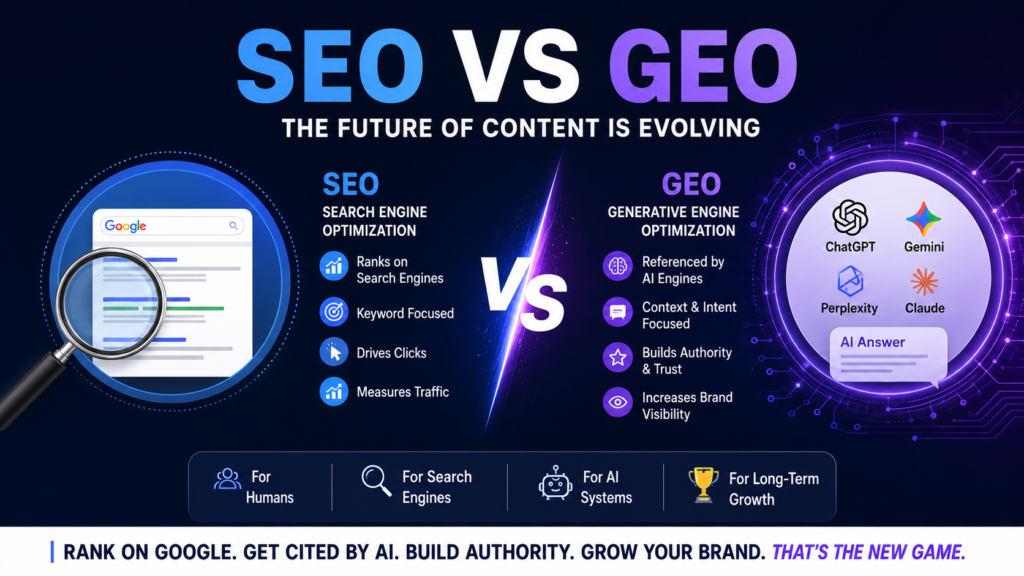
The digital marketing landscape is changing rapidly. For years, businesses focused almost entirely on SEO (Search Engine Optimization) to improve visibility online. Ranking on Google meant traffic, leads, and business growth. But today, a new shift is transforming how people discover information. Instead of typing short keywords into search engines, users are increasingly asking complete questions to AI tools like ChatGPT, Gemini, Claude, and Perplexity. Rather than searching: “best marketing agency” People now ask: “Which marketing agency is best for a startup with a limited budget and strong lead generation needs?” AI tools provide direct answers instead of showing a list of websites. This shift has introduced a new concept in digital marketing: GEO — Generative Engine Optimization And if businesses want to stay relevant in the future, understanding SEO vs GEO is becoming essential. What is SEO? SEO (Search Engine Optimization) is the process of improving a website’s visibility on traditional search engines like Google and Bing. The goal of SEO is simple: Rank higher in search results and attract organic traffic. SEO typically focuses on: For example, if someone searches: “Best home décor products online” Google scans millions of web pages and ranks results based on relevance, authority, and optimization. Traditional SEO is focused on one major objective: Getting clicks. The better your ranking, the more visitors you receive. For years, this strategy worked exceptionally well. But search behavior is evolving. What is GEO? GEO (Generative Engine Optimization) stands for Generative Engine Optimization. Instead of optimizing content only for search engines, GEO focuses on optimizing content for AI-powered answer engines. These include platforms such as: Unlike traditional search engines, AI systems don’t just display websites. They generate direct answers by understanding and summarizing information. For example, instead of searching: “best CRM software” A user may ask: “What is the best CRM for a small business with under 20 employees and automation needs?” AI engines analyze trusted sources and generate a personalized response. This changes the game completely. The question is no longer: “How do I rank on Google?” The new question becomes: “How do I become the source AI trusts and references?” That is GEO. SEO vs GEO: What’s the Difference? Although SEO and GEO are related, they focus on different goals. SEO focuses on visibility in search engines. GEO focuses on visibility inside AI-generated answers. Here’s the simplest way to understand it: SEO helps users find your website.GEO helps AI systems trust your content. Traditional SEO prioritizes: GEO prioritizes: In simple words: SEO = Ranking GEO = Becoming the Answer The smartest businesses today are preparing for both. Why Traditional SEO Alone Is No Longer Enough Many websites still create content filled with repetitive keywords. For example: “Best SEO agency, SEO company, affordable SEO services, top SEO agency near me.” This style of writing worked years ago. But AI systems prefer content that is: Modern users also search differently. Instead of typing: “best digital marketing company” People ask: “Which digital marketing company is best for real estate lead generation?” This means content must answer real problems instead of simply targeting keywords. The future belongs to intent-driven content, not keyword stuffing. The Best Content Strategy in 2026: SEO + GEO Many businesses think they must choose between SEO and GEO. That is a mistake. The strongest strategy today is: SEO + GEO You should create content that: ✔ Ranks on Google✔ Answers questions clearly✔ Builds authority✔ Is understandable by AI systems✔ Provides genuine value The goal is no longer just traffic. The goal is visibility everywhere users search — including AI platforms. Best Practices to Write Content Today If you want your content to perform in both SEO and GEO, follow these modern content practices. 1. Write for Intent, Not Just Keywords Old content strategy focused heavily on keywords. Modern content focuses on: User intent. Ask yourself: What problem is the reader trying to solve? Instead of targeting: “Best Real Estate Marketing” Write: “How to Generate High-Quality Leads for a Real Estate Business” This creates deeper, more useful content. And useful content performs better in both search and AI. 2. Write Like Humans Speak AI systems understand conversational language better. Avoid robotic writing. Bad example: “SEO ranking improve website visibility SERP optimization.” Better example: “SEO helps businesses improve online visibility so potential customers can discover them organically.” Natural language improves: The future of content feels like a conversation. 3. Structure Content Properly Good structure matters more than ever. Use: Clear headings Bullet points FAQs Short paragraphs Numbered sections Why? Because structured content is easier for: Avoid huge blocks of text. Keep information organized and scannable. 4. Answer Questions Directly One of the biggest GEO strategies is: Answer first, explain later. For example: What is GEO? Good answer: GEO (Generative Engine Optimization) is the process of optimizing content so AI systems can understand, trust, and reference it in generated responses. Then explain in detail. This improves both user experience and AI discoverability. 5. Build Authority Around a Topic Publishing random blogs is no longer effective. Instead, become an authority in your niche. For example, if you run a digital marketing business, create content around: When your website consistently covers one topic deeply, both search engines and AI systems trust you more. 6. Add Real Expertise and Experience Generic content is everywhere now. What stands out? Real insights. Instead of saying: “Marketing helps businesses grow.” Share practical knowledge: “In industries like real estate, focused landing pages often outperform general websites because users prefer faster information and clearer trust signals.” Original insights create credibility. And credibility matters more than ever. 7. Include FAQ Sections FAQ sections are highly valuable for GEO because users ask AI questions conversationally. For example: Is SEO dead because of AI? No. SEO is evolving. Search engines still matter, but content must now also be optimized for AI-powered search experiences. Can GEO replace SEO? No. GEO complements SEO. Businesses need both strategies for future visibility. FAQs help AI systems understand your content more effectively. Final Thoughts:
Paid Vs Organic Traffic: What Works Best For Affiliate Campaigns

Every affiliate marketer hits the same crossroad: Do you spend your time or do you spend your money? On one side, you have the “slow and steady” allure of organic traffic, building an audience that trusts you and content that ranks forever. On the other, you have the “instant-on” power of paid traffic, buying your way to the top of the feed and seeing results within your next lunch break. In 2026, the question is not just about which one is “better”; it is about which one fits your specific goals, your bank account and your patient level. What is Organic Traffic? Organic traffic is the art of being discovered organically. It is what happens when someone searches for a solutions and find your blog, video or a social post without a “Sponsored” tag attached with it. ●The Trust Advantage – There is a psychological wright to organic results. Users tend to trust a recommendation more when it feels earned rather than bought. This leads to higher “intent” and a more loyal customer base. ●Compounding ROI – Organic content is an asset. A review you write today will generate commissions three years from now. You pay for it once with your time, and it pays you back indefinitely. ●The Margin Lever – Because you are not paying for every individual click, your profit margins on each sale are higher once you’ve cleared the initial hurdnel of ranking. What is Paid Traffic? Paid traffic is about visibility on demand. It is the ultimate tool for thos who want to skip the line and get directly into the conversion. ●Immediate Feedback – You don’t have to wait months to know if an offer converts. Within 24 hours of launching a paid campaign, you have hard data on what is working and what is not working. ●Targeting – With paid platforms you can be surgical. You can show your affiliate offer only to people of certain age, in a certain city, who have a speciifc interest in the last 48 hours. ●Total Control – You decide exactly how much you want to spend and where that traffic will go. If an offer is performing well, you can “turn the dial” to scale your revenue immediately. Difference Betwen Paid and Organic – An Affiliate Trade Off Feature Organic Traffic Paid Traffic Speed to Result Slow Instant Upfront Cost Low High Trust Level High Low Scalability Linear Exponential Longevity Permanent Temporary Risk Level Quite low High Performance Benchmark – The Numbers Game Organic traffic continues to lead in quality. In 2026, affiliate campaigns driven by organic search report conversion rates 5% – 10% higher than those driven by paid ads, largely due to the “pre-warmed” trust the user has in the source. The global affiliate industry has ballooned into a $19.4 billion powerhouse. While paid search remains the largest driver of total traffic volume, organic content-led affiliates now generate 3.7x more revenue per visitor than those depending solely on traditional display ads. What Works Best? – Organic or Affiliate If you are launching a new product or testing an offer, Paid traffic should be your way to go. It give you the clean data that you need to see if the numbers work before you invest months of effort into it. However, if you are looking to build a sustainable, high-marign business, you cannot ignore organic traffic. It is the only way to build a “Sovereign” territory that cannot be taken away by a sudden spike in ad costs or change in a platform’s bidding algorithm. A successful affiliate campaign in 2026 uses a hybrid model: they use paid to find the winners and organic to own them. FAQs Can I start with paid traffic if I have a small budget? It is risky. Paid traffic is a “testing ground.” If you only have $100, one mistake in your targeting can put burden in your budget before you learn anything. Organic is safer for those who are starting from zero. Is organic traffic “FREE”? No, it can cost time, and time is your most valuable resource. You also likely have costs for SEO tools, hosting and content creation. It is “free” in terms of cost-per-click, but it needs a heavy upfront investment. Why is my paid traffic not converting? Usually, it’s a mismatch of intent. If you are sending people who were scrolling social media to a high-pressure sales page, they aren’t ready. Paid traffic often needs a “bridge” page to warm them up first. How do I know when to scale my paid ads? Once you have a “Positive ROI”, meaning for every $1 you spend on ads, you are making more than $1 in commissions, you are ready to scale. Start by increasing your budget by 10 – 20% and watch if the conversion holds steady.
Paid vs Organic Traffic: What Works Best for Affiliate Campaigns

The basic premise of search engine reputation management is to use the following three strategies to accomplish the goal of creating a completely positive first page of search engine results for a specific term…
SEO Best Practices: Mobile Friendliness

The basic premise of search engine reputation management is to use the following three strategies to accomplish the goal of creating a completely positive first page of search engine results for a specific term…