
SEO vs GEO: The Future of Content Marketing in the Age of AI
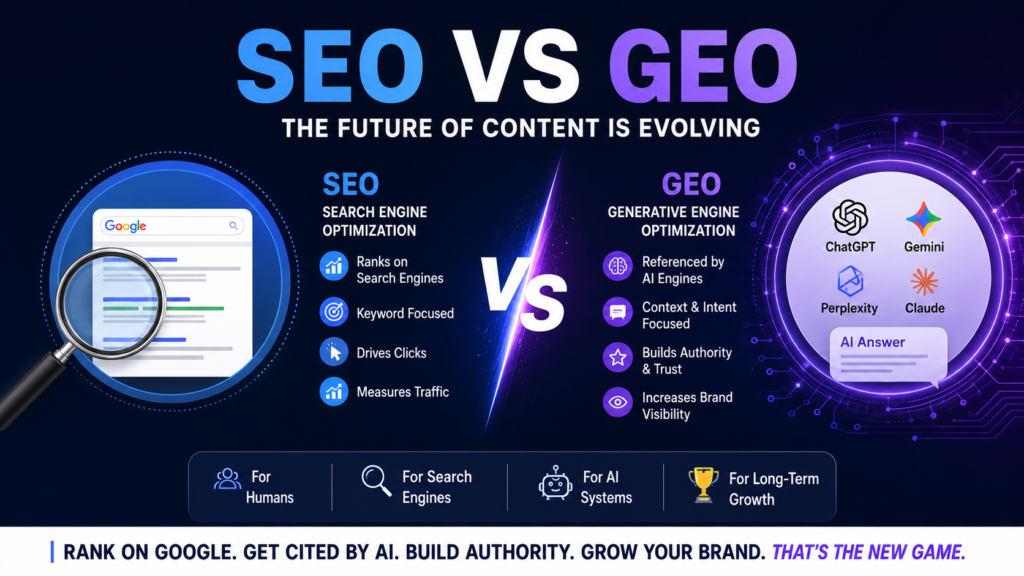
The digital marketing landscape is changing rapidly. For years, businesses focused almost entirely on SEO (Search Engine Optimization) to improve visibility online. Ranking on Google meant traffic, leads, and business growth. But today, a new shift is transforming how people discover information. Instead of typing short keywords into search engines, users are increasingly asking complete questions to AI tools like ChatGPT, Gemini, Claude, and Perplexity. Rather than searching: “best marketing agency” People now ask: “Which marketing agency is best for a startup with a limited budget and strong lead generation needs?” AI tools provide direct answers instead of showing a list of websites. This shift has introduced a new concept in digital marketing: GEO — Generative Engine Optimization And if businesses want to stay relevant in the future, understanding SEO vs GEO is becoming essential. What is SEO? SEO (Search Engine Optimization) is the process of improving a website’s visibility on traditional search engines like Google and Bing. The goal of SEO is simple: Rank higher in search results and attract organic traffic. SEO typically focuses on: For example, if someone searches: “Best home décor products online” Google scans millions of web pages and ranks results based on relevance, authority, and optimization. Traditional SEO is focused on one major objective: Getting clicks. The better your ranking, the more visitors you receive. For years, this strategy worked exceptionally well. But search behavior is evolving. What is GEO? GEO (Generative Engine Optimization) stands for Generative Engine Optimization. Instead of optimizing content only for search engines, GEO focuses on optimizing content for AI-powered answer engines. These include platforms such as: Unlike traditional search engines, AI systems don’t just display websites. They generate direct answers by understanding and summarizing information. For example, instead of searching: “best CRM software” A user may ask: “What is the best CRM for a small business with under 20 employees and automation needs?” AI engines analyze trusted sources and generate a personalized response. This changes the game completely. The question is no longer: “How do I rank on Google?” The new question becomes: “How do I become the source AI trusts and references?” That is GEO. SEO vs GEO: What’s the Difference? Although SEO and GEO are related, they focus on different goals. SEO focuses on visibility in search engines. GEO focuses on visibility inside AI-generated answers. Here’s the simplest way to understand it: SEO helps users find your website.GEO helps AI systems trust your content. Traditional SEO prioritizes: GEO prioritizes: In simple words: SEO = Ranking GEO = Becoming the Answer The smartest businesses today are preparing for both. Why Traditional SEO Alone Is No Longer Enough Many websites still create content filled with repetitive keywords. For example: “Best SEO agency, SEO company, affordable SEO services, top SEO agency near me.” This style of writing worked years ago. But AI systems prefer content that is: Modern users also search differently. Instead of typing: “best digital marketing company” People ask: “Which digital marketing company is best for real estate lead generation?” This means content must answer real problems instead of simply targeting keywords. The future belongs to intent-driven content, not keyword stuffing. The Best Content Strategy in 2026: SEO + GEO Many businesses think they must choose between SEO and GEO. That is a mistake. The strongest strategy today is: SEO + GEO You should create content that: ✔ Ranks on Google✔ Answers questions clearly✔ Builds authority✔ Is understandable by AI systems✔ Provides genuine value The goal is no longer just traffic. The goal is visibility everywhere users search — including AI platforms. Best Practices to Write Content Today If you want your content to perform in both SEO and GEO, follow these modern content practices. 1. Write for Intent, Not Just Keywords Old content strategy focused heavily on keywords. Modern content focuses on: User intent. Ask yourself: What problem is the reader trying to solve? Instead of targeting: “Best Real Estate Marketing” Write: “How to Generate High-Quality Leads for a Real Estate Business” This creates deeper, more useful content. And useful content performs better in both search and AI. 2. Write Like Humans Speak AI systems understand conversational language better. Avoid robotic writing. Bad example: “SEO ranking improve website visibility SERP optimization.” Better example: “SEO helps businesses improve online visibility so potential customers can discover them organically.” Natural language improves: The future of content feels like a conversation. 3. Structure Content Properly Good structure matters more than ever. Use: Clear headings Bullet points FAQs Short paragraphs Numbered sections Why? Because structured content is easier for: Avoid huge blocks of text. Keep information organized and scannable. 4. Answer Questions Directly One of the biggest GEO strategies is: Answer first, explain later. For example: What is GEO? Good answer: GEO (Generative Engine Optimization) is the process of optimizing content so AI systems can understand, trust, and reference it in generated responses. Then explain in detail. This improves both user experience and AI discoverability. 5. Build Authority Around a Topic Publishing random blogs is no longer effective. Instead, become an authority in your niche. For example, if you run a digital marketing business, create content around: When your website consistently covers one topic deeply, both search engines and AI systems trust you more. 6. Add Real Expertise and Experience Generic content is everywhere now. What stands out? Real insights. Instead of saying: “Marketing helps businesses grow.” Share practical knowledge: “In industries like real estate, focused landing pages often outperform general websites because users prefer faster information and clearer trust signals.” Original insights create credibility. And credibility matters more than ever. 7. Include FAQ Sections FAQ sections are highly valuable for GEO because users ask AI questions conversationally. For example: Is SEO dead because of AI? No. SEO is evolving. Search engines still matter, but content must now also be optimized for AI-powered search experiences. Can GEO replace SEO? No. GEO complements SEO. Businesses need both strategies for future visibility. FAQs help AI systems understand your content more effectively. Final Thoughts:
Paid Vs Organic Traffic: What Works Best For Affiliate Campaigns

Every affiliate marketer hits the same crossroad: Do you spend your time or do you spend your money? On one side, you have the “slow and steady” allure of organic traffic, building an audience that trusts you and content that ranks forever. On the other, you have the “instant-on” power of paid traffic, buying your way to the top of the feed and seeing results within your next lunch break. In 2026, the question is not just about which one is “better”; it is about which one fits your specific goals, your bank account and your patient level. What is Organic Traffic? Organic traffic is the art of being discovered organically. It is what happens when someone searches for a solutions and find your blog, video or a social post without a “Sponsored” tag attached with it. ●The Trust Advantage – There is a psychological wright to organic results. Users tend to trust a recommendation more when it feels earned rather than bought. This leads to higher “intent” and a more loyal customer base. ●Compounding ROI – Organic content is an asset. A review you write today will generate commissions three years from now. You pay for it once with your time, and it pays you back indefinitely. ●The Margin Lever – Because you are not paying for every individual click, your profit margins on each sale are higher once you’ve cleared the initial hurdnel of ranking. What is Paid Traffic? Paid traffic is about visibility on demand. It is the ultimate tool for thos who want to skip the line and get directly into the conversion. ●Immediate Feedback – You don’t have to wait months to know if an offer converts. Within 24 hours of launching a paid campaign, you have hard data on what is working and what is not working. ●Targeting – With paid platforms you can be surgical. You can show your affiliate offer only to people of certain age, in a certain city, who have a speciifc interest in the last 48 hours. ●Total Control – You decide exactly how much you want to spend and where that traffic will go. If an offer is performing well, you can “turn the dial” to scale your revenue immediately. Difference Betwen Paid and Organic – An Affiliate Trade Off Feature Organic Traffic Paid Traffic Speed to Result Slow Instant Upfront Cost Low High Trust Level High Low Scalability Linear Exponential Longevity Permanent Temporary Risk Level Quite low High Performance Benchmark – The Numbers Game Organic traffic continues to lead in quality. In 2026, affiliate campaigns driven by organic search report conversion rates 5% – 10% higher than those driven by paid ads, largely due to the “pre-warmed” trust the user has in the source. The global affiliate industry has ballooned into a $19.4 billion powerhouse. While paid search remains the largest driver of total traffic volume, organic content-led affiliates now generate 3.7x more revenue per visitor than those depending solely on traditional display ads. What Works Best? – Organic or Affiliate If you are launching a new product or testing an offer, Paid traffic should be your way to go. It give you the clean data that you need to see if the numbers work before you invest months of effort into it. However, if you are looking to build a sustainable, high-marign business, you cannot ignore organic traffic. It is the only way to build a “Sovereign” territory that cannot be taken away by a sudden spike in ad costs or change in a platform’s bidding algorithm. A successful affiliate campaign in 2026 uses a hybrid model: they use paid to find the winners and organic to own them. FAQs Can I start with paid traffic if I have a small budget? It is risky. Paid traffic is a “testing ground.” If you only have $100, one mistake in your targeting can put burden in your budget before you learn anything. Organic is safer for those who are starting from zero. Is organic traffic “FREE”? No, it can cost time, and time is your most valuable resource. You also likely have costs for SEO tools, hosting and content creation. It is “free” in terms of cost-per-click, but it needs a heavy upfront investment. Why is my paid traffic not converting? Usually, it’s a mismatch of intent. If you are sending people who were scrolling social media to a high-pressure sales page, they aren’t ready. Paid traffic often needs a “bridge” page to warm them up first. How do I know when to scale my paid ads? Once you have a “Positive ROI”, meaning for every $1 you spend on ads, you are making more than $1 in commissions, you are ready to scale. Start by increasing your budget by 10 – 20% and watch if the conversion holds steady.